

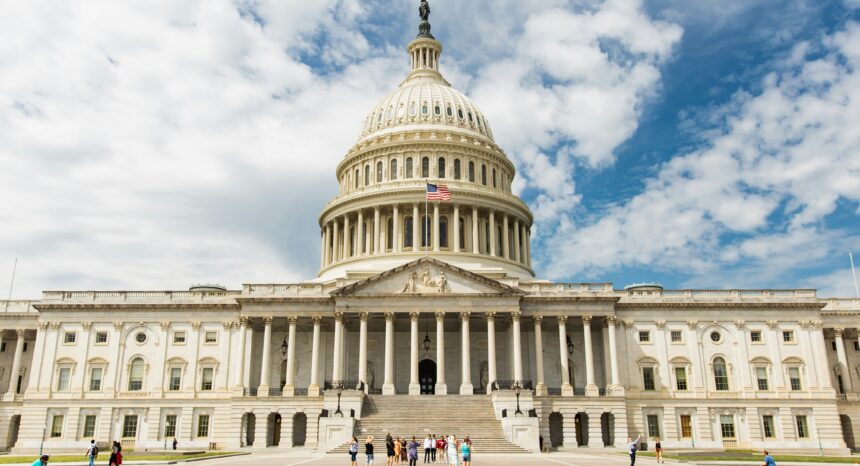


There are substantial differences in the amount, content and characteristics of research papers that Democratic and Republican congressional committees and right- or left-leaning think tanks cite in their policy documents, demonstrating that neither party is taking a full account of scientific evidence on various issues, according to a study published in the journal Science in April.
Although both major political parties in the U.S. increased their use of scientific publications in policy documents from 1995 to 2021, Democratic-controlled congressional committees and left-leaning think tanks are significantly more likely to reference research papers than their Republican counterparts, the study finds.
“The thing that was surprising for me was how consistent the results were wherever we looked,” says Alexander Furnas, one of the study authors and a research assistant professor in the Center for Science of Science and Innovation at the Kellogg School of Management at Northwestern University. “We found that in every field, every issue, Republicans are citing less [science] than Democrats and that the overlap of how often [the two parties] actually cite the same exact paper is quite low.”
Science plays a critical role in policymaking. As Americans and American politics are experiencing a profound polarization around science and trust in scientists, the findings underscore the threat to the perception of science as a politically neutral, trusted source of information, note Furnas and his co-authors, Timothy LaPira, a political science professor at James Madison University, and Dashun Wang, the director of the Center for Science of Science and Innovation at the Kellogg School.
The study also raises important questions about the two political parties’ ability to have a shared set of facts, their selective use of science to support party agendas and the effectiveness of policies when they’re not grounded in comprehensive evidence.
“There are already various other reasons that it’s hard to find common ground, and this probably makes it worse,” Furnas says.
Science has become politically divisive over the past several decades, and the COVID-19 pandemic further accelerated this politicization.
A recent survey of 31,062 U.S. adults between April and June 2025 finds that while support for research remains strong, the proportion of Americans reporting high trust in scientists declined from 58% in 2020 to 36% in 2025. There were sharper drops among Republicans, from 54% to 26%, than among Democrats, from 67% to 50%, according to the Civic Health and Institutions Project.
How they conducted the study
The study is one of the first to include a large-scale analysis of research paper citations in congressional committees and think tank documents across 23 fields of science — from mathematics and law to health and economics — and 17 policy topics, including health, labor, law and justice, and environment.
“It was a really unique insight into research translation of a variety we don’t normally see, and there’s so much the paper does that I think just hasn’t really been done before,” says Matthew Motta, associate professor of Health Law, Policy & Management at Boston University’s School of Public Health, and author of the recent book “Anti-Scientific Americans.” He was not involved in the study.
Furnas and his co-authors analyzed two large databases.
Using Overton, a large international database of policy documents and their citations, the researchers analyzed 641,894 documents published by the federal government and think tanks in the United States from 1995 to 2021. Included were 49,345 congressional committee reports since 1995 and committee hearings since 2001, as well as 191,118 policy documents published by 121 U.S.-based ideological think tanks after 1999.
They also used Dimensions, a large AI-enhanced database that links publications and citations with grants, patents, clinical trials, datasets and policy papers. It includes more than 122 million scientific publications across all disciplines.
To examine the partisan differences in the use of science in policy, the researchers matched 424,199 scientific references in the policy documents in Overton with the Dimensions database.
The authors chose to focus on documents from congressional committees and think tanks for specific reasons.
Congressional committees play a crucial role in information gathering and serve as a site of partisan competition to frame issues, making them well-suited to study the partisan uses of science, the authors write.
Meanwhile, think tanks serve as key resources for partisan policymakers, setting agendas and incubating policy alternatives. Think tanks are often staffed by researchers who change jobs among government, political parties and campaign organizations.
To measure trust in science, researchers also conducted two surveys.
One survey included nearly 3,500 “political elites,” defined as congressional staffers, political journalists, lobbyists and nonprofit advocates, judges, clerks, and state and local government officials.
The other survey included 1,000 people from the public who were likely to vote.
What they found
The authors analyzed the data from various angles. Below is a summary of their findings:
Volume of cited science
- Overall, citation of science in policy documents increased steadily from less than 20% in 1995 to more than 35% in 2020, especially in think tank documents. But the positive change masks the partisan divide in citation of science.
- On average, committees controlled by Democrats were 1.8 times more likely to cite science than Republican ones during the study period. When looking at the trends over time, this gap has widened, the analysis finds. Results held up when researchers accounted for variables such as House or Senate chamber, document type, and whether the U.S. President belonged to the same party.
- The difference between think tanks was more notable. On average, left-leaning think tanks were 5 times more likely to cite science than right-leaning ones. Similar to congressional committees, the gap between the two has widened over time.
- When control of a committee switched from Republican to Democratic, there was an average increase of 196 additional citations to science per committee in the congressional term after the switch.
- These disparities were consistent across time, scientific fields and policy issues. Democratic committees cited science more than Republican committees across 20 of 23 scientific fields and 15 of the 17 policy topics.
Differences in the content of cited science
- There was very little overlap between the research papers that both parties cited in their documents. Only 5% to 6% of the papers were cited by both parties.
- The low level of overlap persisted across scientific fields and policy issues.
Differences in the topics discussed in committees
- There was also very little overlap at the topic level between the two parties, the analysis reveals. For instance, at the House Energy and Commerce Committee, Democrats were more likely to cite studies on abortion, e-cigarettes, guns, energy production and mental health. Republicans were more likely to cite studies about health insurance costs, opioids, air pollution, or high-school athletic injuries.
- Researchers observed a similar trend when comparing right-leaning and left-leaning think tanks.
Science referenced for the same issue
- In this analysis, there was also very little overlap between the two parties. The researchers matched documents on minimum wage policy by two think tanks — left-of-center Urban Institute and right-of-center Employment Policies Institute. While the Urban Institute referenced several papers about the distributional effects of minimum wage laws, EPI cited papers almost exclusively about the employment and labor supply effects of minimum wage increases.
- Of the 62 papers cited across the two policy documents, only one was used by both think tanks.
Quality of cited science
- Democratic committees were more likely to cite peer-reviewed science (48% to 44%), highly-cited “hit” papers — defined as the top 5% of the most cited papers in their field and year — and slightly older publications, compared with Republican committees. This difference was slightly greater for think tanks (44% to 38%). Left-leaning think tanks were also more likely to reference papers that were published more recently.
- “In other words, Democratic and left-of-center organizations tend to cite science that is more in line with the work that scientists themselves consider important, which is true for both Congress and think tanks,” the authors write.
Surveys of trust in science among policymakers
- About 44% of Democratic “political elites” said they completely trusted scientists to create unbiased and accurate knowledge, compared with 10% of Republicans.
- Also, 96% of Democratic elites said they either completely or partially trusted scientists to create knowledge that is unbiased and accurate, compared with 64% of Republican “elites.”
- When asked about the trustworthiness of the National Academies of Sciences, Engineering, and Medicine, 61% of Democratic elites rated NASEM as “very trustworthy,” compared with 23% of Republicans.
- Political elites, regardless of party, trusted science more than the general public, but when the authors compared the results of the surveys of political elites versus the general public, they found a larger partisan divide among elites than the general public.
Study limitations and future research
Researchers caution that their findings must be interpreted with care.
For instance, although science is important, it’s not the only source of information for policymakers, who may also draw from the news media, trade publications, interest groups, industry and lobbyists.
Also, researchers find that even though Republicans may cite fewer scientific studies, that doesn’t mean that they use less evidence overall, or rely more on non-university, non-research resources than Democrats. It’s possible that the parties rely on sources of evidence that this research study doesn’t capture, the authors write.
In further exploring the divide, the authors wondered whether Republicans use hearings and committee activities more as tools for partisan messaging. But that was not the case. There was no clear link between partisan speeches and how much science gets cited. In other words, political messaging doesn’t fully explain the disparity either.
Another possibility for this gap in scientific citation is that Democrats cite more scientific studies because more of the science is aligned with their priorities, Furnas and his co-authors note. Understanding how the political leanings of scientists affect what gets studied — and how it’s used — is an area that needs more research, they add.
Also, this analysis doesn’t capture the difference in policymaking documents at the state level, Motta says.
“It’s at the state legislatures where you see a lot of this pro- and anti-science action happening on many different fronts,” Motta says. “Efforts to ban the use of fluoride in water are happening in state legislatures, or efforts to roll back vaccine mandates … I do think we need to look to the states more, and a [study] like this lays the foundation for doing that.”
The primary barrier to conducting similar research at the state level is a lack of datasets comparable to those used by Furnas and his colleagues. Motta said he and his team are working on finding a solution.
Furnas and his team are now working to identify and analyze the small pool of scientific papers that were referenced by both parties as a potential bridge across ideological divides.
Advice for journalists
The study is a reminder for journalists to be more vigilant than ever when reviewing documents from congressional committees and think tanks. A recent example is a Trump administration “Make America Healthy Again” report, which cited several studies that don’t exist.
“The question to me becomes, are we seeing examples of science being weaponized, being used to achieve ideological ends, rather than good governance as an objective? And when do we see science being weaponized in that way?” asks Motta. “And I would argue, for example, we’re about to get a huge dose of this in just a couple of months.”
Motta is referring to Health and Human Services Secretary Robert F. Kennedy Jr.’s promise to find the cause of autism by September this year, a deadline he later pushed by six months, to early next year.
“So, to me, this is one of the things we’re going to have to be really careful about going forward, thinking about the ways in which science is weaponized toward anti-scientific goals,” Motta says.
He advises journalists to ask how any one claim or a series of claims relate to the broader academic literature.
“Is this something that most scientists think is an accurate way of thinking about the world?” Motta asks. “And then I think the other thing to do is to get scientists to talk about how their research, or the research of their peers, relates to those claims that are being levied. Is it the case that scientists have good reason to accept those claims as true or false?
“So often, I think journalists focus on one study and the claims it makes without trying to, one, interrogate whether or not those findings are good ones, but two, to situate that data in the broader literature,” Motta says.

Expert Commentary