




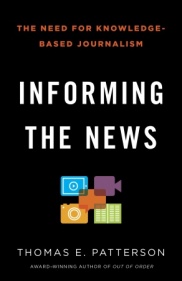
The following is an essay developed from the new book Informing the News: The Need for Knowledge-Based Journalism, which serves as companion to Journalist’s Resource and represents an articulation of the project’s mission to help the news media transition to a new phase in their 21st-century development.
Its author, Thomas E. Patterson, is the Bradlee Professor of Government and the Press at the Harvard Kennedy School’s Joan Shorenstein Center on the Press, Politics and Public Policy. He helped found the Journalist’s Resource project and serves as its research director.
Accompanying this essay are video interviews that provide additional insights into the theory and practice of “knowledge-based journalism.” The studies, research and materials on which it is based are listed at bottom. The book is available from Amazon.com, Barnes & Noble and local retailers such as the Harvard Book Store.
______________
“It does not matter that the news is not susceptible of mathematical
statement. In fact, just because news is complex and slippery,
good reporting requires the exercise of the highest scientific virtues.”
— Walter Lippmann((Walter Lippmann, Liberty and the News (Princeton, NJ: Princeton University Press, 2008), 74.))
In a 2012 article, Pulitzer Prize-winning journalist Linda Greenhouse challenged reporters who had given voice to David Rivkin’s views on national security. Rivkin had served in the Reagan and first Bush administrations and invariably took “the other side” in stories that criticized the second Bush administration’s handling of the war on terrorism. Said Greenhouse: “As a surrogate, a ‘go-to-proxy,’ [Rivkin] is simply filling a role assigned to him by reporters and — let’s assume — editors who accept unquestionably the notion that every story has another side that it is journalism’s duty to present. But there is another side to that story, too — one that calls on journalists to do their best to provide not just the facts, but also — always — the truth.”((Linda Greenhouse, “Challenging ‘He Said, She Said’ Journalism,” Nieman Reports, 66 (Summer 2012), 24.))
“Truth” is the holy grail of journalism. In the late 1990s, two dozen of the nation’s top reporters, calling themselves the Committee of Concerned Journalists, held a series of public forums to address what its members saw as declining news standards. Over a period of two years, the committee met with three thousand reporters and citizens to exchange ideas about the purpose of journalism.((Bill Kovach and Tom Rosenstiel, The Elements of Journalism (New York: Three Rivers Press, 2001), 2-4.)) The resulting “Statement of Shared Principles” identified “truth” as journalism’s standard:
“[J]ournalistic truth” is a process that begins with the professional discipline of assembling and verifying facts. Then journalists try to convey a fair and reliable account of their meaning, valid for now, subject to further investigation. Journalists should be as transparent as possible about sources and methods so audiences can make their own assessment of the information. Even in a world of expanding voices, accuracy is the foundation upon which everything else is built — context, interpretation, comment, criticism, analysis and debate. The truth, over time, emerges from this forum.((“A Statement of Shared Principles,” Committee of Concerned Journalists, Washington, D.C.))
The committee members were careful to say that “journalistic truth” is not truth in the ordinary sense of the word, much less in the way philosophers understand it. Journalistic truth is a “sorting out” process that occurs over time through interaction “among the public, newsmakers, and journalists.”((Kovach and Rosenstiel, The Elements of Journalism, 44-41.)) Committee members Bill Kovach and Tom Rosenstiel said that journalists get at “the truth in a complex world by first stripping information of any misinformation, disinformation, or self-promoting bias and then letting the community react…. The search for truth becomes a conversation.”((Ibid, 44-45.))
 There is no reason to question reporters’ determination to deliver what journalist Carl Bernstein calls “the best obtainable version of truth.”((Quoted in ibid, 43.)) And it’s easy to find examples of accurate reporting. Yet, reporters fall far short of delivering “truth.” Studies show, for example, that economic coverage typically lags behind major shifts in the macro-economic cycle. Existing story lines can linger in the news months after the economic conditions that gave rise to them have changed.((S. Robert Lichter and Ted J. Smith, “Bad News Bears,” Media Critic 1 (1994): 81-87.)) Nor is economic reporting the exception. Studies have found that social conditions are often misreported.((Jorgen Westerstahl and Folke Johansson, “News Ideologies as Molders of Domestic News,” European Journal of Communication 1 (1986): 126-43.)) As for forecasting — predicting how events will unfold — journalists’ judgments, as one study concluded, are “repeatedly, wildly wrong.”((James Curran, Media and Democracy (London: Routledge, 2011), 97-110; see also Thomas E. Patterson, Out of Order (New York: Knopf, 1993), 176-79.))
If news is truth, there appear to be at least two versions of it, one for print journalists and one for television journalists.((See, for example, Thomas E. Patterson and Robert D. McClure, The Unseeing Eye (New York, Putnam, 1976).)) A Washington State University study found that local TV and newspaper reporters portray U.S. Senate campaigns differently — so differently, in fact, that voters could reasonably conclude they are witnessing different contests. “The priorities of newspapers and local television news seldom overlapped,” is how the research team described its findings.((Travis N. Ridout and Rob Mellon, Jr., “Does the Media Agenda Reflect the Candidates’ Agenda?” The Harvard International Journal of Press/Politics 12 (2007): 58.))
When journalists speak of truth in news, they often have a narrow conception in mind, one that boils down to the accuracy of specific facts.((Kovach and Rosenstiel, The Elements of Journalism, 5.)) Did Senator Smith actually say the words attributed to her? Did last year’s trade deficit actually top $400 billion? Some news organizations retain fact checkers to verify such claims. But fact checkers don’t address the fundamental question: Is the story itself “true”? A story can be accurate in its particulars — what was said, when and where it happened, who witnessed it, and so on — and yet falter as a whole. Even if the facts check out, however, the story would not be true for that reason alone.((Jack Fuller, What Is Happening to News: The Information Explosion and the Crisis in Journalism (Chicago: University of Chicago Press, 2010), 139.)) Early coverage of the Afghan war, for example, was often accurate in its particulars but off the mark in its assessments of Afghan society and the likely course of the war.((Rachel Smolkin, “Media Mood Swings,” American Journalism Review, June 2003.))
Even “the facts” can be elusive. A 2005 study of fourteen local newspapers funded by the Knight Foundation found that three-fifths of their stories contained an error. Some errors were minor, as in the misspelling of a name. Others were more significant, as in the case of a misleading headline or faulty claim. None of the newspapers had a low error rate. “Neither stature of the paper nor market size,” the study concluded, “[was] closely associated with accuracy.”((Scott R. Maier, “Accuracy Matters: A Cross-Market Assessment of Newspaper Error and Credibility,” Journalism and Mass Communication Quarterly 82 (2005): 546.))
If not truth, what is the essential characteristic of news? The Washington Post’s David Broder came close to describing it when he said: “My experience suggests that we often have a hard time finding our way through the maze of facts — visible and concealed — in any story. We often misjudge character, mistake plot lines. And even when the facts seem most evident to our senses, we go astray by our misunderstanding and misjudgment of the context in which they belong.”((David Broder, Beyond the Front Page (New York: Simon & Schuster, 1987), 19. Quoted in Kathleen Hall Jamieson and Paul Waldman, Press Effect: Politicians, Journalists, and the Stories that Shape the Political World (New York: Oxford University Press, 2003), 195.))
The knowledge problem
In their influential book, The Elements of Journalism, Kovach and Rosenstiel say that journalists’ “discipline of verification” is what allows them to hone in on the truth. “The discipline of verification,” they write, “is what separates journalism from entertainment, propaganda, fiction, or art. Entertainment — and its cousin ‘infotainment’ — focus on what is most diverting. Propaganda selects facts and invents them to serve the real purpose: persuasion and manipulation. Fiction invents scenarios to get at a more personal impression of what it calls truth. Journalism alone is focused on getting what happened down right.”((Kovach and Rosenstiel, Elements of Journalism, 79-80.))
Kovach and Rosenstiel acknowledge that journalists’ discipline of verification is largely “personal and idiosyncratic.”((Ibid, 79.)) “The notion of an objective method of reporting,” they write, “exists in pieces, handed down by word of mouth from reporter to reporter.”((Ibid, 83.)) “While not following any standardized code,” they say, “every journalist operates by relying on some often highly personal method of testing and providing information — his or her own individual discipline of verification.”((Ibid.))
Whether what Kovach and Rosenstiel describe is a discipline is open to question. Does a method that is “intensely personal and idiosyncratic” qualify as a discipline? If there is no “standardized code,” wouldn’t it be better to describe journalism as a practice guided by conventions? Recognizing the objection, Kovach and Rosenstiel propose five “intellectual principles” as the basis for “a science of reporting”:
- Never add anything that was not there.
- Never deceive the audience.
- Be as transparent as possible about your methods and motives.
- Rely on your own original reporting.
- Exercise humility.((Ibid, 89.))
Each of these principles has its logic. Conspicuously absent from the list, however, is knowledge.
Almost alone among leading professions, journalism is not rooted in a body of substantive knowledge.((See, J. Goldstein, “Foucault among the sociologists: The ‘disciplines’ and the history of the professions,” History and Theory, 1984 (XVIII): 175.)) The claim is not that journalists lack knowledge or skill, for that is far from true. Nor is the claim an entry into the perennial but ultimately fruitless debate over whether journalism is a craft rather than a profession.((Everett C. Dennis and John C. Merritt, Media Debates: Great Issues for the Digital Age, 5th ed. (Belmont, Calif: Wadsworth, 2006), 190-99.)) The claim instead is a precise one: journalism is not grounded in a systematic body of substantive knowledge that would protect its practitioners’ autonomy and guide their judgment.((As the term is used in this paper, knowledge refers to established patterns and regularities based on conceptual frameworks or theories. Knowledge is more than mere information or conventional understandings. It is systematic information. As the ensuing discussion will point out, journalism lacks such a knowledge base, both in an absolute sense and relative to disciplines such as economics, medicine, and law, or even political science and sociology. A related point, which is central to an understanding of journalism’s shortcomings, is that knowledge is a key to devising accurate interpretations of what is observed or factually recorded.))
Medicine, law, and the sciences, even economics and psychology, have disciplinary knowledge that guides practitioners’ decisions, narrowing the choices and reducing the chances of error. Journalists have no such advantage. Although there is a theoretical knowledge of journalism, it is not definitive, nor is its mastery a prerequisite for practice.((See Paul Godkin, “Rethinking Journalism as a Profession,” Canadian Media Studies Journal, 4 (2008): 111.)) Although a majority of journalists have a college degree in journalism, many have a degree in a different field and some have no degree at all.((For a detailed profile of the education and training backgrounds of journalists, see David H. Weaver, Randal A. Beam, Bonnie J. Brownlie, Paul S. Voakes, and G. Cleveland Wilhoit, The American Journalist in the 21st Century (Mahwah, N.J.: Lawrence Erlbaum Associates, 2007), 31-53.))
 Journalists are often in the thankless position of knowing less about the subject at hand than the newsmakers they are covering, a reversal of the typical situation, where the professional practitioner is the knowledgeable party. During the Persian Gulf War, journalists who visited the Pentagon Press Office were greeted with a sign that read, “Welcome Temporary War Experts.”((Cited in Bartholomew H. Sparrow, Uncertain Guardians: The News Media as a Political Institution (Baltimore, Maryland: Johns Hopkins University Press, 1999), 58.)) To be sure, journalists acquire expertise as a result of being on the same news beats for lengthy periods, but this form of expertise does not compare with that of many newsmakers or most professionals. Doctors, lawyers, and engineers are masters of their own house in a way that journalists are not.
Journalists’ knowledge deficit does not appear to be a major concern within their profession. In 2008, the Knight Foundation created a blue-ribbon commission aimed at strengthening journalism so that it could better serve communities’ “information needs.” None of the panel’s fourteen recommendations spoke to journalism’s knowledge deficit.((“Informing Communities: Sustaining Democracy in the Digital Age,” report of the Knight Commission on the Information Needs of Communities in a Democracy, April 7, 2010.)) Yet the public has a sense of it. In a Freedom Forum study, journalist Robert Haiman found that, although the public “respects the professional and technical skills [of] journalists,” it feels that journalists “don’t have an authoritative understanding of the complicated world they have to explain to the public.” In the five cities (Nashville, New London, Phoenix, San Francisco, and Portland, Oregon) where he held public forums, Haiman heard repeated complaints from local civic and business leaders who questioned reporters’ preparation. “We heard stories,” he writes, “about reporters who did not know the difference between debt and equity, who did not know basic legal terminology used in a trial, and who had little idea of how manufacturing, wholesaling, distributing, and retailing actually work and relate to each other.”((Robert J. Haiman, “Best Practices for Newspaper Journalists,” a handbook prepared for The Freedom Forum’s Free Press/Fair Press Project, The Freedom Forum, Arlington, Virginia, September 3, 2002, 23.))
It is not all that hard for journalists, or anyone else for that matter, to devise explanations. What’s harder to do is to come up with reliable ones. Noting the dysfunctional behavior of political leaders in 2010, a leading journalist wrote: “Barring a transformation of the Democratic and Republican parties, there is going to be a serious third party candidate in 2012 … one definitely big enough to impact the election’s outcome.”((Thomas Friedman of the New York Times, cited in Brendan Nyhan and John Sides, “How Political Science Can Help Journalism (and Still Let Journalists Be Journalists),” The Forum 9 (2011): 8.)) Such commentary is harmless enough and enables the journalist to say “I told you so” when the prediction comes true. Nevertheless, a deeper understanding of the dynamics of America’s party politics would have tempered the claim. Whatever the indicators in 2010 of a viable third-party effort, they could not possibly have been as persuasive as the counter-indicators. Strong third-party candidacies are rare and for a host of reasons. Political scientists Brendan Nyhan and John Sides identify some of them: “party loyalty, ballot access, fundraising difficulties, the lack of organizational infrastructure, voters’ unwillingness to ‘waste’ their vote.”((Brendan Nyhan and John Sides, “How Political Science Can Help Journalism (and Still Let Journalists Be Journalists),” The Forum 9 (2011): 8.)) Even when institutional obstacles can be overcome, a more imposing one exists, as Americans Elect discovered in 2012. Formed by prominent Democrats and Republicans concerned about the increasingly level of party polarization, Americans Elect secured ballot access for a third-party candidate and obtained funding commitments from major donors. Yet, it was forced to abandon its third-party effort upon failing to get a leading politician to head the ticket. It’s been a century since the last truly prominent politician, Theodore Roosevelt, was willing to take on the challenge.
Journalists’ knowledge deficiency is a reason they are vulnerable to manipulation by their sources. Sometimes a source might be disinterested, but the safe bet is that newsmakers are slanting their arguments.((Lippmann, Public Opinion, 217-18; Hugh Heclo, “Campaigning and Governing: A Conspectus,” in Norman J. Ornstein and Thomas E. Mann, eds. The Permanent Campaign and Its Future, (Washington, D.C.: American Enterprise Institute and Brookings Institution, 2000), 3.)) Knowing this, a good journalist will be on guard but, says journalist Jack Fuller, it is not enough for the journalist “to smell this sort of thing.”((Fuller, What Is Happening to News, 139.)) Skepticism is a weak defense against sources that fabricate facts or hide them. Unless reporters have an understanding of where the truth resides, they find themselves, as the Washington Post’s Walter Pincus put it, in the position of “common carriers, transmitters of other people’s ideas and thoughts, irrespective of import, relevance, and at times even accuracy.”((Walter Pincus, “Newspaper Narcissism: Our pursuit of glory led us away from readers,” Columbia Journalism Review, May/June 2009.))
Without a working knowledge of the subject at hand, journalists are also vulnerable to the experts from whom they seek information, quotes, and story leads. Many experts are dispassionate in their pursuit of knowledge, but others have an agenda. Sometimes it stems from a core personal or political belief. In other instances, the agenda is that of a sponsor, as in the case of some medical researchers who accept funding from pharmaceutical firms. Reporters, says Fuller, “must be capable of dealing with experts from a position of strength.”((Quoted in Bob Giles, “Universities Teach Journalists Valuable Lessons,” Nieman Reports, spring 2001.))
Conventional wisdom is no substitute for knowledge. Consider the example of obesity. Until the 1990s, it was portrayed by journalists as a personal problem that was the result of family genetics and eating disorders. Heavy-set people were either born that way or eat far too much. In 1996, the National Center for Health Statistics (NCHS) made public for the first time a large amount of systematic evidence on obesity, including the then-startling finding that half of Americans were overweight and that a quarter were obese. Within a few years, according to Regina Lawrence’s Shorenstein Center study, the framing of obesity stories had changed dramatically. Although the “personal” frame was still in use, most stories were now framed in “systemic” terms. NCHS had concluded that personal predispositions could not explain the rapid rise in obesity levels, particularly among children and adolescents. NCHS singled out systemic factors, including the aggressive marketing of sugar-laced cereals and cholesterol-laden fast foods. “We don’t sell children guns, alcohol or drugs,” said Dr. Walter Willett of Harvard University in a New York Times article, “but we do allow them to be exploited by food companies.”((Regina Lawrence, “Framing Obesity: The Evolution of News Discourse on a Public Health Issue,” The International Journal of Press/Politics, 9-3 (Summer 2004), 56-75.))
Walter Lippmann’s unheeded call
When the journalist Walter Lippmann spelled out a vision of a more systematic form of journalism in Liberty and the News (1920) and Public Opinion (1921), his fellow journalists were among the biggest detractors.((Edwin Emery, The Press in America: An Interpretive History of Journalism, 2nd ed. (Englewood Cliffs, N.J.: Prentice-Hall, 1962), 735.)) As they saw it, reporting was not an intellectual pursuit but instead a job for hard-nosed men of common sense.((Kevin Barnhurst, unpublished book manuscript, 2009, ch. 2, 7.)) Paul Radin, a leading anthropologist of the early twentieth century, characterized the journalist as “a man of action” rather than “a thinker.”((Paul Radin, Primitive Man as Philosopher (New York: Dover, 1927).))
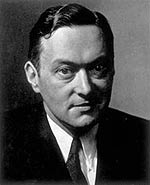
When the 1947 Hutchins Commission on Freedom of the Press echoed Lippmann’s claim that journalism needed a deeper knowledge base,((Robert D. Leigh, A free and Responsible Press (Chicago: University of Chicago Press, 1947), 23.)) the writers at Editor and Publisher fired back, dismissing the commission’s report as the work of “11 professors, a banker-merchant and a poet-librarian.”((Quoted in Stephen Bates, “Realigning Journalism with Democracy: The Hutchins Commission, Its Times, and Ours,” The Annenberg Washington Program of Northwestern University, Washington, D.C., 1995, 23.)) A New York Herald Tribune columnist belittled the report: “[A] good $150-a-week newspaper man would have been ashamed to do as little work for a three-week assignment.”((Lewis Gannett, “A Free and Responsible Press,” New York Herald Tribune, 28 March 1947, 24.)) Los Angeles Times managing editor L.D. Hotchkiss said, “Outside of Walter Lippmann, I can think of no working newspaperman who could stand confinement with [the commission] members for any length of time.”((Quoted in Bates, “Realigning Journalism with Democracy,” 10.))
Modern journalists are leagues apart from the crusty newsmen of yesteryear.((Guido H. Stempel, III, and Hugh M. Cuthbertson, “The Prominence and Dominance of News Sources in Newspaper Medical Coverage,” Journalism Quarterly 61 (1984): 671-76; Tony Atwater and Norma Green, “New Sources in Network Coverage of International Terrorism,” Journalism Quarterly 65 (1988): 676-71; D. Charles Whitney, Marilyn Fritzler, Steven Hones, Sharon Mazzarella, and Lana Rakow, “Geographic and Source Biases in Network Television News 1982-1984, Journal of Broadcasting & Electronic Media 33 (1989): 159-74.)) Most journalists today are college graduates and receptive to expert judgments.((Kevin G. Barnhurst, “The Makers of Meaning,” Political Communication 20 (2003): 1-22.)). Roughly a fifth of the sources cited in their news stories are scholars, professionals, former officials, and the like.((D. Charles Whitney, Marilyn Fritzler, Steven Jones, Sharon Mazzarella, and Lana Rakow, “Geographic and Source Biases in Network Television News 1982-1984,” Journal of Broadcasting and Electronic Media 33 (1989):159-74.)) Although some of these “experts” are more skilled at delivering sound bites than at analyzing policy,((Lawrence Soley, The News Shapers: The Sources Who Explain the News (New York: Praeger, 1992).)) the world of knowledge and the world of the newsroom are closer together today than ever before.((Kevin Barnhurst, unpublished book manuscript, 2009.))
There is also greater expertise within journalism. Although they are still a small fraction of the profession, the number of reporters with advanced degrees in fields such as science, health, economics, and law has steadily increased. A few journalists, like David Sanger and Andrew Revkin, have acquired substantial reputations inside and outside the profession for deeply informed reporting. American University’s Matthew Nisbet calls them “knowledge journalists,” noting that they regularly apply “deductive, specialized understanding to problems.”((Matthew Nisbet, “Nature’s Prophet,” Paper Series, Joan Shorenstein Center on the Press, Politics, and Public Policy, John F. Kennedy School of Government, Harvard University, Fall 2012, 3.))
Nevertheless, journalists have been relatively slow to apply systematic knowledge to their everyday work. As Pincus noted recently, there are major policy areas where few journalists, anywhere, know the subject truly well.((Pincus, “Newspaper Narcissism.”)) American journalists are trained in gathering and presenting information,((Dennis and Merritt, 196.)) which are substantial skills but not ones that require subject proficiency.
For more than a century, journalists have relied on two basic tools — observation and interviewing.((Journalism education in the United States has mirrored journalism practice. For the most part, students are instructed in the skills of the craft and taught how to construct a broadcast, print, or online story. Few journalism schools systematically train students how to access, gain command of, and apply subject-matter knowledge. Three decades ago, a top-level commission of journalists and practitioners criticized journalism schools for being “little more than industry-oriented trade schools.” Changes have occurred since then, but journalism schools still lag far behind business and public policy schools in the application of knowledge. Economics, management science, and even social psychology are now an integral part of a business school or public policy school education. Although these schools still puzzle over how best to align practice and scholarship, they have achieved a fuller integration of the two than have journalism schools.)) Reporters are trained to look first to the scene of action and then to the statements of interested parties. Observation and interviewing are highly useful tools, which is why they been in use for so long. They are also tools that require judgment and experience if they are to be used properly.((C.W. Anderson, Emily Bell, and Clay Shirky, “Post-Industrial Journalism: Adapting to the Present,” Tow Center for Digital Journalism, Columbia School of Journalism, Columbia University, New York, New York, 2012. )) Nevertheless, like all such tools, observation and interviewing have limits. They fail, says journalist Robert Niles, to provide “us instruction on how to test the accuracy of information we receive.”((Robert Niles, “A Journalist’s Guide to the Scientific Method, and Why It’s Important,” Online Journalism Review, August 23, 2011.)) Even when they yield reliable information, observation and interviewing enable journalists to capture only those aspects of developments that are observable and that available parties are able and willing to talk about.((Kevin Barnhurst, unpublished book manuscript, 2009, ch. 2, 10; C. Tavris, “How to Publicize Science,” 21-32 in J.H. Goldstein, ed., Reporting Science: The Case of Aggression (Hillsdale, N.J.: Lawrence Erlbaum, 1986).))
Invented by American journalists in the nineteenth century,((Before journalists developed the interview as a reporting tool, reporting was based largely on documents and personal observation. By the early 1900s, the interview was a mainstay of American journalism. It gradually became a reporting tool in other countries, though more limited in its use.)) the interview is likely the handiest reporting tool ever devised. Interviewing relieves the journalist of having to undertake more demanding forms of investigation, and the interviewee’s words can be treated as “fact” insofar as the words were actually said.((Kathleen Hall Jamieson and Karlyn Kohrs Campbell, The Interplay of Influence, 5th ed. (Belmont, Calif.: Wadsworth, 2001), 72.)) Yet, the interview is not foolproof. Who is interviewed, what is asked, and even the time and place of the interview can affect the answers. Responses are subject to mistakes of memory or even a source’s determination to mislead a reporter, as was the case in front-page New York Times stories that stemmed from White House officials’ hoodwinking of reporter Judith Miller during the lead up to the 2003 Iraq invasion.
As regards observation, its usefulness is limited by the fact that it occurs at a particular time and from a particular perspective. Aspects of public life that are not in the line of sight get less scrutiny than those that are. Lobbying activities, for example, are reported less often than election activities, not because they have far less influence on public policy, but because they are less visible. For the same reason, policy problems are underreported, until they take the form of an obtruding event. In the two decades leading up to the Occupy Wall Street movement in 2011, the gap in income between America’s wealthy and its poor steadily increased. Yet, as a study by Fortune’s Nina Easton found, the income gap rarely made news. Not until it erupted into a grassroots movement did it catch journalists’ attention. “Before these protesters … set up camp in New York City’s Zuccotti Park on September 17 [2011],” wrote Easton, “few in the media took notice of a growing body of scholarly research showing that America’s rich are getting richer, even in years when middle-class incomes stagnate.”((Nina Easton, “Rebelling Against the Rich,” Joan Shorenstein Center on the Press, Politics, and Public Policy, John F. Kennedy School of Government, Harvard University, September 2012, 2.))
Journalists’ knowledge deficit is a reason that contextual information has never been their strong suit.((Robert Entman, Democracy Without Citizens: Media and the Decay of American Politics (New York: Oxford University Press, 1989); Shanto Iyengar, Is Anyone Responsible? (Chicago: University of Chicago Press, 1991).)) In 1947, the Hutchins Commission on Freedom of the Press concluded that reporters routinely fail to provide a “comprehensive and intelligent account of the day’s events in a context that gives them some meaning.”((Quoted in Melvin Mencher, “Will the Meaning of Journalism Survive?” Nieman Reports June 2006, web version.)) Communication scholar Doris Graber found that news stories typically provide the “who,” “what,” “where,” and “when” of developments but often omit the “why.”((Graber, Processing Politics, 145.)) When stories do offer a “why,” it is often too thin to be instructive. A study of economic news coverage, for example, concluded that journalists’ explanations “tend to [be] episodic, shallow and formulaic, focusing on the most obvious short-term effects…. Linkages rarely go beyond the simplistic level of … [the] explanation that ‘the dropping dollar got a lift today, and that pushed up stocks on Wall Street.’”((S. Robert Lichter and Ted J. Smith, “Bad News Bears,” Media Critic 1 (1994): 82.))
Knowledge is a key to strengthening story context. For almost any development of even modest complexity, journalists cannot be counted upon to construct “a comprehensive and intelligent account” unless they are knowledgeable of the underlying factors. Context, says journalism professor Samuel Freedman, tells “how momentary events fit into the larger flow of politics or culture or history.”((Quoted in ibid, 94.)) “We’re supposed to make those connections,” says Columbia University’s Nicholas Lemann.((Nicholas Lemann, “Research Chat: Nicholas Lemann on journalism, scholarship, and more informed reporting,” Journalist’s Resource, June 20, 2012.))
The digital promise
In the 1970s, Philip Meyer, a Knight-Ridder national correspondent who went on to become a journalism professor at the University of North Carolina, argued that reporters needed “new tools.” Noting the rapid advance of the social sciences, Meyer said scholars were “doing what we journalist like to think of ourselves as best at: findings facts, inferring causes, pointing to ways to correct social problems, and evaluating the effects of such correction.”((Philip Meyer, Precision Journalism (Bloomington: Indiana University Press, 1973), 4, 14.)) In Precision Journalism, Meyer argued that journalists should make “the new high-powered research techniques our own”((Ibid, 13.)) and proceeded chapter-by-chapter to show journalists how to apply social science methods such as polls and field experiments.
Meyer’s pioneering ideas acquired a following in some journalism schools and influenced the work of some reporters, particularly those engaged in polling and data analysis.((Stephen K. Doig, “Reporting with the Tools of Social Science,” Nieman Reports (Spring 2008): 48-49.)) Its impact was limited, however, by the fact that the slow speed of primary research conflicts with the fast pace of daily journalism. The limits of time and observation make it difficult for journalists to apply the data gathering and analytic methods of the social scientist. Lippmann suggested instead a pragmatic approach. Rather than becoming adept at conducting basic research, journalists would become adept at applying research knowledge to reporting situations.((Lippmann, Public Opinion, 227.))
 Some in journalism would question whether even that approach is realistic, arguing that the puzzles and routines of journalism have little in common with those of science. Even as late as the mid-1990s, a survey funded by the Freedom Forum found that most journalists and journalism educators were resistant to making journalism a more systematic discipline.((B. Medsger, “Winds of Change: Challenges Confronting Journalism Education,” Freedom Forum, Arlington, VA: 1996.)) In fact, there are some key differences between science and journalism. Deadlines, time and space limitations, the need to attract and hold the audience’s attention — these factors are distinctly journalistic in nature.((Michelle K. McGinn and Wolff-Michael Roth, “Preparing Students for Competent Scientific Practice: Implications of Recent Research in Science and Technology Studies,” Educational Researcher, Vol. 28, No. 3 (Apr., 1999), 14-24 Published by: American Educational Research Association. See also, N. Roll-Hansen, “Science, politics, and the mass media: On biased communication of environmental issues,” Science, Technology, & Human Values, 19 (1994): 324-41; Matthew Yglesias, “Political Science and Political Journalism,” Yglesias.thinkprogress.org, March 12, 2009.)) Moreover, as Nyhan and Sides say, reporters don’t have the option of ignoring “events that are not well-understood.”((Brendan Nyhan and John Sides, “How Political Science Can Help Journalism (and Still Let Journalists Be Journalists), The Forum 9 (2011): 1.))
Nevertheless, there are parallels between scientific inquiry and reporting. “Although the vocabularies differ,” says communication scholar Kevin Barnhurst, “the [journalistic and scientific] processes closely parallel each other. Both attend to occurrences out there, formulating guesses (which become events or hypotheses), both resolve issues to arrive at facts (or theories), and both seek to establish truth (or a paradigm).”((Kevin Barnhurst, unpublished book manuscript, 2009, ch 3, p.11.))
The increased application of two types of knowledge would improve the accuracy of news and heighten its contribution to the public’s understanding of public affairs: content knowledge, which is knowledge of a subject, and process knowledge, which is knowledge of how reporting methods affect news content and impact. The first of these will require a division of labor in that no single journalist can master more than a fraction of what reporters are asked to cover. Even some subfields of journalism will require a degree of specialization. “As the pace of new developments in science and technology quickens,” says former Washington Post science reporter Cristine Russell, “[science] journalists are increasingly confronted with covering complicated technical information as well as the potential social, legal, religious, and political consequences of scientific research. Avian flu, embryonic stem cell research, genetic engineering, global warming, teaching of evolution, and bio-terrorism are just a few of the topics on [science] journalists’ plates today.”((Christine Russell, “Covering Controversial Science: Improving Reporting on Science and Public Policy,” Working Paper Series #2006-4, Joan Shorenstein Center on the Press, Politics, and Public Policy, John F. Kennedy School of Government, Harvard University, Spring 2006, 2.))
The second knowledge skill — an understanding of the communication process — has been nearly overlooked by journalism practitioners. Studies indicate that most journalists are largely unaware of how their reporting tools and story constructions affect story content and audience response.((Joseph P. Bernt, Frank E. Fee, Jacqueline Gifford, and Guido H. Stempel III, “How Well Can Editors Predict Reader Interest in News?” Newspaper Research Journal, 21(2000): 2-10.)) It would be as if teachers had only a vague idea of the instructional techniques that help students learn. Admittedly, journalists don’t have the face-to-face interactions with their readers and listeners that teachers have with their students. News audiences are out of sight and therefore harder to comprehend. Nevertheless, unless journalists develop a better understanding of their audience — an area in which mass communication research provides guidance — they will miss opportunities to inform it, as studies of attribution and framing bias have shown.((See, for example, Shanto Iyengar, Is Anyone Responsible?))
Journalism may have reached a point where change is possible. Its culture is markedly different today than in times past. Skepticism about the value of knowledge has diminished as a result of undeniable scientific advances and the influx into the profession of college-educated practitioners. To be sure, tensions remain. Compared with faculties in other professional schools, for instance, scholars and practitioners on journalism school faculties are more deeply split over the issue of how to best train their students.((See Stephen D. Reese, “The Progressive Potential of Journalism Education: Rethinking the Academic versus Professional Divide,” Harvard International Journal of Press/Politics 4 (1999): 70-91.)) Nevertheless, journalism practice and education have increasingly embraced knowledge as a tool of reporting. “We can support research that strengthens and informs those who are making change and apply our scholarship to the practice ourselves,” says former Des Moines Register editor Geneva Overholser, now on the faculty of the University of Southern California.((Geneva Overholser, “Keeping Journalism, and Journalism Education, Connected to the Public,” Nieman Journalism Lab, September 11, 2012.))
The Internet has reduced the obstacles to knowledge-based reporting. At an earlier time, the difficulty of accessing systematic studies and public records made it impractical for journalists to consult these materials on a regular basis. Today, reliable information on a wide range of news subjects is readily accessible through the web. “Never has it been so easy to expose an error, check a fact, crowdsource, and bring technology to bear in service of verification,” says the Poynter Institute’s Craig Silverman.((Craig Silverman, “A New Age for Truth,” Nieman Reports, 66 (Summer 2012), 4.)) However, the process is not foolproof. The Internet is at once a gold mine of solid content and a hell hole of misinformation. Unless the reporter knows something about the subject at hand, the odds of a mistake are uncomfortably high. Even peer-reviewed scholarly studies available through the Web can be misleading. Some are deeply flawed and most require interpretation to apply them accurately to reporting situations.
 If tapping the Internet for information is all that knowledge-based journalism comes to mean, it will not reach its potential.((For a comparable example from another profession, see Christopher Johns, “Framing Learning through Reflection within Carper’s Fundamental Ways of Knowing Nursing,” Journal of Advanced Nursing 22 (1995): 226.)) It will represent the injection of knowledge into news stories rather than the application of knowledge to reporting. There’s a big difference between the two. As Cambridge University scientist W. I. B. Beveridge noted, knowledge enables the investigator to notice things that would otherwise go unnoticed or be misinterpreted.((Quoted in Melvin Mencher, “Will the Meaning of Journalism Survive?” Nieman Reports, June 2006.)) It’s difficult to imagine a more accurate type of journalism that does not have knowledge as a core element. Without the guiding hand of knowledge, the chances of miscalculation are high. In early 2011, reporters described the protest demonstrations taking place in Cairo’s Tahrir Square as a “pro-democracy movement.” “Protesters Press for Voice in Egyptian Democracy” is how the Associated Press headlined the departure from power of President Hosni Mubarak on February 11.((Lee Keath and Hadeel Al-Shalchi, “Protesters Press for Voice in Egyptian Democacy,” Associated Press , March 12, 2011.)) Many of the protesters were indeed seeking to install a Western-style democratic system in Egypt. However, other protesters had a different political system in mind, one closer in kind to Egypt’s governing traditions. As it turned out, as foreign policy experts had cautioned, their view prevailed in the aftermath of the Egyptian revolution.
Knowledge does not always yield precise answers. It can complicate reporters’ task by alerting them to what’s not known as well as to what’s known. Sometimes, the effect of knowledge is to unearth new questions or uncertainties. Even the “facts” can be elusive. Once they are determined, facts serve as a point of agreement, but they are not always easy to pin down.((Jeffrey Scheuer, The Big Picture: Why Democracies Need Journalistic Excellence (New York: Routledge, 2008), 46-47.)) “Most people think science is about facts and are quite frustrated when they find that science is in large part about uncertainty,” says Gilbert Omenn, former chair of the American Association for the Advancement of Science.((Quoted in Russell, “Covering Controversial Science,” p. 36.)) Nevertheless, the surest way to improve the accuracy of news is for journalists to make fuller use of knowledge. There’s no lack of it, and it’s expanding at breathtaking pace. By one estimate, the storehouse of human knowledge is doubling every decade.((Todd Oppenheimer, “Reality Bytes,” Columbia Journalism Review 35 (September/ October 1996): 40-42.)) Enough of it touches on public affairs that few policy areas now fall outside its scope.
Knowledge could keep journalists from becoming outmoded and being outflanked. In a report for Columbia University’s Tow Center for Digital Journalism, C. W. Anderson, Emily Bell, and Clay Shirky note that what journalists have traditionally done — identifying newsworthy events — is now being done also by citizens while what media outlets have traditionally leveraged — analyzing recent developments — is now being done also by specialty sites and scholars. During the 2012 presidential campaign, for example, historian Jack Bohrer posted a 10,000 word article on Mitt Romney’s family background that attracted more than 125,000 visitors and was passed along through social media to an additional 750,000 people.((Peter Hamby, “Did Twitter Kill the Boys on the Bus?” in draft, Joan Shorenstein Center on the Press, Politics, and Public Policy, John F. Kennedy School of Government, Harvard University, Spring 2013, p. 64.)) Anderson, Bell, and Shirky argue that journalists, if they are to remain competitive, will have to change from “the production of initial observations to a role that emphasizes verification and interpretation.”((Anderson, Bell, and Shirky, “Post-Industrial Journalism.”)) If this claim is even somewhat correct, journalists and news outlets will have no choice but to base more of their work on knowledge.
The threat, and the challenge
Changes in how journalism operates won’t happen just because there might be a better way. A receptive attitude within the profession is required, as are mechanisms for bringing about constructive change. Adjustments in management practices and business school education, for example, did not occur until advances in microeconomics and organizational theory made a new approach feasible.((See Rakesh Khurana and J.C. Spender, “Herbert A. Simon on What Ails Business Schools: More Than A Problem in Organizational Design,” Journal of Management Science, 49 (2012): 619-39.))
Whether journalism will meet the challenges posed by today’s information environment is an open question. The press, like any institution, is conservative in its routines. Traditional ways of defining, structuring, and gathering the news are built into every facet of journalism practice. “What is of enduring importance,” Wilbert Moore wrote in The Professions, “is the homely truth that new knowledge or innovations in technique and practice threaten the very basis upon which established professionals rest their claims to expert competence.”((Quoted in Philip Meyer, The Vanishing Newspaper (Columbia: MO: University of Missouri Press, 2006), 233.))
Newer developments could also blunt a shift toward knowledge-based journalism. While the Internet provides access to a heretofore unavailable storehouse of knowledge, it also pressures journalists to crank out stories and have a constantly-updated presence through blogs, Twitter, Facebook, and other social media. Speed can be an obstacle to reflective reporting. Nevertheless, it is a mistake to see knowledge as informing only slower paced and longer form reporting. In virtually every reporting situation, the journalist who knows more about the subject at hand has an advantage over the journalist who knows less. When reporters must file quickly, without the opportunity to observe or conduct interviews, they have no place to turn except to what they already know. Knowledge is the best eraser of hastily concocted but wrongheaded storylines.
Thomas E. Patterson is Bradlee Professor of Government and the Press at the Harvard Kennedy School’s Shorenstein Center on the Press, Politics and Public Policy. He is a founder of Journalist’s Resource and serves as research director.
Tags: training, ethics
______________

Expert Commentary