
China, Development, Human Rights

World Bank: Poverty Levels in the Developing World

Tags: , ,

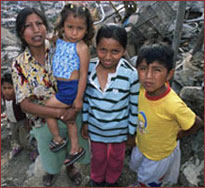
Peru_WorldBank

In 2012, the World Bank updated its estimates of global poverty rates. The results for the latest years studied — 2005 to 2008 — indicated that the percentage of people living below the poverty line declined for all six regions studied. This was the first decline over a three-year period since 1981.

The 2005-2008 findings are based on 850 surveys compiled from 130 developing countries; the surveys included 1.23 million households and provided a statistical snapshot of some 90% of the population of the developing world. For the purposes of the estimates, those unable to spend $1.25 a day on consumption (after adjusting for inflation and exchange rates) were classified as poor.

The findings of the World Bank’s “Global Poverty Estimate” (PDF) include:

  • The number of people living below the $1.25-a-day poverty line declined from 1.94 billion (52% of the population of the developing world) in 1981 to 1.29 billion (22%) in 2008, a 33.5% drop. Those living on less than $2 a day also declined, from 2.59 billion total in 1981 to 2.47 billion people in 2008, a drop of 4.6%.
  • East Asia saw the most dramatic declines in poverty rates, from 77% of its population in 1981 to 14% in 2008. The Middle East and North Africa region saw poverty fall from 9.6% in 1981 to 2.7% in 2008. Over the same time period, South Asia saw its population under the poverty measure decline from 61% to 36%.
  • China’s efforts to alleviate poverty accounted for a significant amount of global reduction, with its rate going from 84% in 1981 to 13.1% in 2008. On average, total poverty in the developing world declined by 1.05 percentage points per year between 2005 and 2008; when China is excluded, the reduction is 0.54 percentage points per year.
  • For the first time since 1981, less than half of the population of sub-Saharan Africa lived below the $1.25-a-day poverty line. Between 1981 and 2008, the region’s population living below the poverty line declined 4 percentage points, to 47%.
  • By 2010, using the $1.25 a day poverty measure, developing countries had achieved the United Nations Millennium Development Goal of halving the incidence of poverty rates in 1990. Eastern Europe and Central Asia reached this goal in 2008.
  • Although poverty rates in developing countries (excluding China) declined from 41% to 25% between 1981 and 2008, population growth has generally kept up with poverty reduction: “At the current rate of progress there will still be around 1 billion people living below $1.25 per day in 2015.”
  • While the number of people living on between $1.25 and $2 a day has nearly doubled — from 648 million in 1981 to 1.18 billion in 2008 — the rate of those earning more than $2 a day has slowed. Those living on between $1.25 and $2 a day remain particularly vulnerable, as they are only covering their most basic expenses and are subject to the risk of slipping under the $1.25 line should they face an adverse income shock.
  • Nearly 649 million of those who moved above the $1.25 poverty line had a standard of living that was nevertheless below what would be defined as “poor” in middle-income developing countries and far below that of rich countries.

The report notes that basing poverty calculations solely on consumption expenditures fails to capture spending on health, education and other indicators. These should be considered together with consumption-based poverty measures to gain a more holistic picture of the degree of poverty experienced, they suggest.

Tags: poverty, human rights, Africa, Asia, China


By | March 19, 2012

Media analysis

Read the study-related New York Times article titled "Dire Poverty Falls Despite Global Slump, Report Finds."

  1. Reporter's use of the study: Evaluate what the reporter chose to include and exclude from the study. Would the audience have acquired a clear understanding of the study's findings and limits from this article?
  2. Reporter's use of other material: Assess the material in the article that is not derived from the study. For example: Does the reporter place the study in the context of other research and to what effect? Does the reporter include reactions to the study from other researchers or interested parties (e.g., political groups, business leaders, or community members) and are their credentials or possible biases made clear?

Study analysis

Read the full World Bank report (PDF) on poverty in the developing world.

  1. What are the study's key technical term(s)? Which ones need to be put into language a lay audience can understand?
  2. Do the study’s authors put the research into context and show how they are advancing the state of knowledge about the subject? If so, what did the previous research indicate?
  3. What is the study’s research method? If there are statistical results, how did the scholars arrive at them?
  4. Evaluate the study's limitations. (For example, are there weaknesses in the study's data or research design?)
  5. How could the findings be misreported or misinterpreted by a reporter? In other words, what are the difficulties in conveying the data accurately? Give an example of a faulty headline or story lead.

Newswriting and digital reporting assignments

  1. Write a lead, headline or nut graph based on the study.
  2. Spend 60 minutes exploring the issue by accessing sources of information other than the study. Write a lead (or headline or nut graph) based on the study but informed by the new information. Does the new information significantly change what one would write based on the study alone?
  3. Compose two Twitter messages of 140 characters or fewer accurately conveying the study’s findings to a general audience. Make sure to use appropriate hashtags.
  4. Choose several key quotations from the study and show how they would be set up and used in a brief blog post.
  5. Map out the structure for a 60-second video segment about the study. What combination of study findings and visual aids could be used?
  6. Find pictures and graphics that might run with a story about the study. If appropriate, also find two related videos to embed in an online posting. Be sure to evaluate the credibility and appropriateness of any materials you would aggregate and repurpose.

Class discussion questions

  1. What is the study’s most important finding?
  2. Would members of the public intuitively understand the study’s findings? If not, what would be the most effective way to relate them?
  3. What kinds of knowledgeable sources you would interview to report the study in context?
  4. How could the study be “localized” and shown to have community implications?
  5. How might the study be explained through the stories of representative individuals? What kinds of people might a reporter feature to make such a story about the study come alive?
  6. What sorts of stories might be generated out of secondary information or ideas discussed in the study?

1 comment

You can follow any responses to this entry through the RSS 2.0 feed. You can leave a response, or trackback from your own site.

World Bank: Poverty Levels in the Developing World – Journalist’s … « Inclusive Business Asia by Javier Ayala Mar 19, 2012 22:03

[...] Via journalistsresource.org Like this:LikeBe the first to like this post. [...]

Leave a comment