

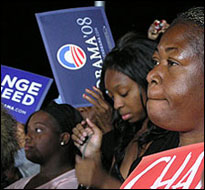

Minorities vote at lower rates in the United States, but the precise reasons are the subject of debate. Differences in education levels and resources — which are both correlated with turnout levels across racial groups — help explain varying turnout rates to some extent, but scholars are also studying other subtle factors.
A 2011 study from the University of California, Riverside, and the University of Exeter, “Getting Out the Vote: Minority Mobilization in a Presidential Election,” examines data from the from the 2004 National Annenberg Election Study (NAES), 2004 American National Election Study (ANES) and the 2004 Miami Exit Poll. Published in the journal Political Behavior, the study develops what the authors call the “differential contact thesis” — the idea that, though outreach efforts often target minority groups, the most effective get-out-the-vote techniques are frequently not used to mobilize them. Of course, campaigns have a variety of tactics available, including direct mail, phone calls and door-to-door canvassing.
The study’s findings include:
- “Minorities are both less likely to be contacted by the major parties and, when contacted, are the recipients of less effective methods. More specifically, minorities are less likely to be contacted in-person — the method that is most likely to motivate participation.”
- Civic groups that try to motivate all voters, regardless of ideology, are important, but these interactions have limitations: “Contact from non-partisan groups positively affects recipients’ probability of voting, [but] it is not as effective as mobilization by the major parties.”
- “White voters were distinctly advantaged by being more likely to receive an in-person get-out-the-vote plea than any other group: twice as likely as Haitian voters in our estimates…. In short, our data indicate a tendency for partisan mobilization efforts to exacerbate inequalities based on resources but also on ethnicity and not just because of the incidence of mobilization but also its quality.”
The authors conclude the following: “Our findings suggest that minorities may not be harder to mobilize; they may simply be the recipients of mobilization efforts that are less effective in bringing them to the polls…. Our data cannot say what lies behind this but we do not wish to imply that it is a conscious strategy by the parties; more likely it is a consequence of other factors such as socioeconomic characteristics, residential mobility, and other residential patterns — which was suggested by our findings concerning in-person contact in the home as opposed to on the street — that make the parties unwilling to expend their most labor intensive efforts on minorities. Nevertheless, the implications for minority participation are profound.”
In the 2012 U.S. election cycle, a number of new voter ID requirements have stirred up debate about their potentially disproportionate effects on minorities. A research roundup, “Voter ID, Voting Rights and Election 2012,” examines some of these dynamics.
In addition, a 2012 paper from George Mason University (PDF) uses experiments to examine tactics of intentional “demobilization” of voters and explores how misinformation can be combatted around election day.
Tags: Latino, Hispanic, African-American

Expert Commentary