

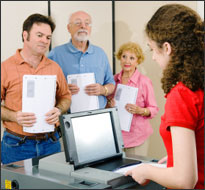

In response to the controversial 2000 U.S. presidential election, Congress passed the Help America Vote Act (HAVA) two years later. Among its provisions was financial assistance to enable states to replace traditional voting machines — including those responsible for Florida’s notorious “hanging chads” — with direct-recording electronic (DRE) devices intended to be more accurate and secure.
A 2012 report titled “Voting: What Has Changed, What Hasn’t and What Needs Improvement,” from the CalTech and MIT Voting Technology Project, examines issues related to new voting equipment and provides an overview of the state of voting in America. The authors estimate that “between 4 million and 6 million votes were lost in the 2000 presidential election: 1.5 to 2 million because of voting equipment and ballot problems; 1.5 to 3 million due to problems with voter registration; At least 1 million due to problems in polling places.”
The report notes that the estimated number of voters who report failing to vote due to polling place problems has fallen in recent election cycles, and the figure stood at an estimated 407,000 in 2008, or 0.31% of voters. But the report also notes continuing irregularities at polling places: “Voters who used electronic machines waited longer than users of paper ballots in 2008. African Americans waited longer than whites. Residents of urban areas waited longer than residents of rural and suburban areas. Yet none of these demographic factors accounts for the vast differences in wait times across states. This suggests that it is the administrative practices embodied in state laws and regulations that are responsible for long lines where they exist.”
In 2008, an estimated 1 million voters were affected at the polls by issues of intimidation, according to the CalTech/MIT report. A 2011 study published in Public Opinion Quarterly, “Political Norms and the Private Act of Voting,” analyzes data from national opinion polls as well as Election Day field experiments to examine how voters perceived new voting methods at polling places. Since the reforms stemming from the 2000 election, concerns have been raised about new machines, which are not always surrounded by the privacy booth or screens that accompanied traditional voting systems. The researchers were based at Brigham Young University and University of California, San Diego.
The study’s findings include:
- Voters whose political opinions were not aligned with the predominant norms of their community were less likely to trust the privacy of the ballot booth: Only 65% of voters in the political minority said they were very confident that their ballot would be counted accurately; by comparison, 86% of voters in the political majority felt the same way.
- Voters who perceived themselves as being outside the political majority also doubted the fairness of the electoral process: “Minority voters scored 27 percentage points lower than majority voters on a measure of whether they were very confident in the fairness of the election process.”
- When asked what they valued most when they came to vote, 43% of voters included privacy as one of their two most important values.
- A field experiment revealed that, if no special measures were taken to increase privacy in a traditional voting setting, “fully one-quarter of political minority voters expressed concern that a poll worker could observe their choices, and more than a fifth of minority voters worried about other voters being able to see their ballot.”
- In a voting center that had increased privacy safeguards, a “much smaller percentage of minority voters believed it was likely that another voter or poll worker was able to glimpse at their ballots.” Such safeguards included black-and-yellow tape on the floor delineating the privacy boundaries of booths and prominent signs reminding people to respect voter privacy.
- In the traditional voting setting, poll workers crossed into privacy zones an average of nine times every 35 minutes, compared to just once in a center with enhanced privacy protections. Similarly, in a normal voting setting, voters enter the privacy zone of others nearly six times per observation period, but just over three times per observation period in the room with enhanced protections.
“These findings raise concerns about whether the voting process can adequately meet the two challenges of protecting a voter’s privacy and ensuring satisfaction with the voting process,” the researchers conclude. Moreover, they note that “as electoral jurisdictions become increasingly homogeneous or consider new forms of voting, the effects of acting against political norms generated by community or group identities need to be a key part of our efforts to determine the optimum choice for democracy.”
It should also be noted that Election Day 2012 raised emerging issues around digital technology, social media and the use of video and photography by voters in polling places.
Tags: civil rights, privacy

Expert Commentary