



To reduce the dependence of the United States on oil imports, in 2007 Congress enacted the Energy Independence and Security Act, which set a target of 36 billion gallons of fuel based on renewable sources being produced domestically by 2022. With incentives and mandates in place, U.S. biofuels quickly became a significant part of the energy picture: Biodiesel production approached 1 billion gallons in 2011, while ethanol reached 14 billion gallons, just over 10% of the approximately 136 billion gallons of liquid fuels consumed that year.
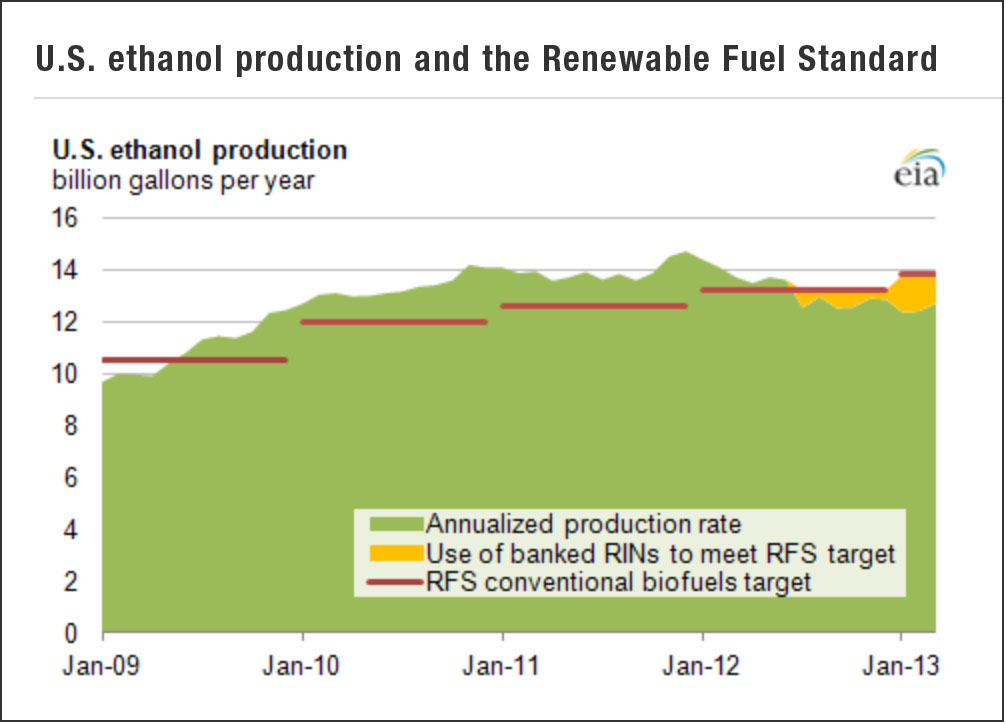
Like any energy source, however, biofuels have broad array of environmental and health impacts. That biofuels are crop-based may seem like an advantage — if you need more, just grow more — but there are limits and downsides, too: Feedstock supplies can be volatile, something recent droughts have brought home, and in 2012 U.S. ethanol production began to fall behind the Renewable Fuel Standard as harvests suffered. The U.S. Energy Information Agency illustrates how U.S. corn ethanol production “grew considerably from 2006 through 2012,” but as the 2012 drought took its toll, production dropped and more producers had to rely on credits they had built up from previous years — referred to, in government jargon, as Renewable Identification Numbers (or “RINs”):
In addition, every bushel of corn used to produce fuel is one that doesn’t go to feed the world. More acres of corn and soybeans could be planted, but at the cost of increased land-use change, pollution and water consumption. The solution could be “second-generation biofuels” — produced by algae, plant cellulose or other means — and increasing levels of production were built into the Energy Independence and Security Act. Technical progress has lagged, however, and a federal appeals court overturned that part of the mandate in January 2013, arguing that it was too ambitious. Also the subject of considerable debate is bio-based fuels’ supposed advantages in reducing greenhouse gas emissions. A 2012 meta-analysis indicates that depending on a variety of factors, biofuels could be 30% less carbon intensive than fossil fuels — or nearly four times as carbon intensive.
For all the big questions, the impact of biofuels is also intensely local. Government policies can make the difference between a good year and a bad one for farmers — or complicate an already difficult situation: As the drought in the summer of 2012 dragged on, U.S. biofuel interests, livestock producers and farmers wrangled over whether the ethanol mandate should be suspended — it required that nearly half of the domestic corn production go to ethanol refineries, not feedlots. Consumers play their role, too: Energy-use per capita is expected to fall 20% by 2040 compared to 2000, with more people choosing hybrids and all-electric vehicles; this is good for the environment, but pushes the ethanol market toward the “blend wall” — the point at which industrial capacity exceeds maximum possible demand.
The local effects of this debate are myriad, reflected in diverse media coverage: on state laws that could affect fuel standards; on high-school science projects; and even on a Maine company’s helping touring rock bands score some biodiesel.
The problems and challenges remain diffuse. A September 2012 issue of Agricultural Research Magazine, published by the U.S. Department of Agriculture, provides a good overview of current topics. The editors note in their introduction: “The commercial growth and long-term viability of renewable fuels in this country are impeded by a number of technical and economic barriers.” A 2011 U.S. Government Accountability Office report, “Challenges to the Transportation, Sale and Use of Intermediate Ethanol Blends,” anticipates a number of looming problems. For global perspective, a 2013 study published in the science journal PLoS One, “Yield Trends Are Insufficient to Double Global Crop Production by 2050,” highlights the short- and long-term shortfalls implied by growing world demand.
Below is a list of studies on issues related to biofuel production and consumption, including public attitudes, health effects, land-use changes, environmental consequences and the long-term outlook.
———————————
“Public Attitudes Toward Biofuels: Effects of Knowledge, Political Partisanship and Media Use”
Cacciatore, Michael A.; Binder, Andrew R.; Scheufele, Dietram A.; Shaw, Bret R. Politics and the Life Sciences, 2012, 31(1-2), 36-51. doi: http://dx.doi.org/10.2990/31_1-2_36.
Abstract: “Despite large-scale investments and government mandates to expand biofuels development and infrastructure in the United States, little is known about how the public conceives of this alternative fuel technology. This study examines public opinion of biofuels by focusing on citizen knowledge and the motivated processing of media information. Specifically, we explore the direct effects of biofuels knowledge and the moderating effect of partisanship on the relationship between media use and benefit vs. risk perceptions in the following four domains: environmental impacts, economic consequences, ethical/social implications, and political ramifications. Our results suggest that more knowledgeable respondents see fewer benefits of biofuels relative to risks, and that Democrats and Republicans are affected differently by media use when forming opinions about biofuels. Among Democrats, greater attention to political media content leads to a more favorable outlook toward the technology across several domains of interest, while among Republicans, an increase in attention to political content has the opposite effect.”
“Regional Water Implications of Reducing Oil Imports with Liquid Transportation Fuel Alternatives in the United States”
Jordaan, Sarah M.; Anadon, Laura Diaz; Mielke, Erik; Schrag, Daniel P. Environmental Science and Technology, 2013, 47 (21), 11976-11984. doi: 10.1021/es404130v.
Abstract: “The Renewable Fuel Standard (RFS) is among the cornerstone policies created to increase U.S. energy independence by using biofuels. Although greenhouse gas emissions have played a role in shaping the RFS, water implications are less understood. We demonstrate a spatial, life cycle approach to estimate water consumption of transportation fuel scenarios, including a comparison to current water withdrawals and drought incidence by state. The water consumption and land footprint of six scenarios are compared to the RFS, including shale oil, coal-to-liquids, shale gas-to-liquids, corn ethanol, and cellulosic ethanol from switchgrass. The corn scenario is the most water and land intense option and is weighted toward drought-prone states. Fossil options and cellulosic ethanol require significantly less water and are weighted toward less drought-prone states. Coal-to-liquids is an exception, where water consumption is partially weighted toward drought-prone states. Results suggest that there may be considerable water and land impacts associated with meeting energy security goals through using only biofuels. Ultimately, water and land requirements may constrain energy security goals without careful planning, indicating that there is a need to better balance trade-offs. Our approach provides policymakers with a method to integrate federal policies with regional planning over various temporal and spatial scales.”
“Shifting Lands: Exploring Kansas Farmer Decision-Making in an Era of Climate Change and Biofuels Production”
White, Stacey Swearingen; Selfa, Theresa. Environmental Management, February 2013, Vol. 51, Issue 2, 379-391. doi: 10.1007/s00267-012-9991-6.
Abstract: “This paper uses the state of Kansas as an example to examine factors that are influencing farmer decision-making during a time of heightened debates about climate and energy. Drawing on interviews with key informants and Kansas farmers, we apply and refine a conceptual model for understanding farmer decisions. We find that farmers have largely positive perceptions of the natural environment. Climate change, especially, is not a salient concern at this time. Factors that appear most likely to influence farmer decisions to adopt a new practice include the relative advantage of that practice and the ability to learn about and discuss it through existing social networks. Successful policy incentives must provide farmers with a continued sense of both independence and contribution to greater societal good.”
“Providing Numbers for a Food versus Fuel Debate: An Analysis of a Future Biofuel Production Scenario”
Poudel, Biswo N.; Paudel, Krishna P.; Timilsina, Govinda; Zilberman, David. Applied Economic Perspectives and Policy, September 2012, Vol. 34, Issue 4, 637-668. doi: 10.1093/aepp/pps039.
Abstract: “This study provides a quantitative estimate of grain that would be available for biofuel production under different scenarios of dietary requirements in the world in 2050 based on the projected information available in 2007 on population, productivity increase, dietary requirements and land-use types. Our major findings are as follows: (1) if dietary requirements do not increase by more than 20% from the current level, crop yields from current cropland must increase by more than 57% just to meet dietary demand; (2) the restriction of pastureland for milk and meat production purposes would imply insufficient food production for a moderate diet consumption scenario in 2050; (3) If food demand increases by 20% of the current consumption level, a 60% increase in crop yield and a 16% conversion of pasturelands would meet grain demand and leave surplus grain to supply 23% of liquid fuel demand. We also highlight the potential roles played by biotechnology, research and development fundings, irrigation, and cropping intensity to boost crop production and ultimately make more land available for biofuel production if such an option continues to be considered in future.”
“How Good Politics Results in Bad Policy: The Case of Biofuel Mandates”
Lawrence, Robert Z. Harvard Kennedy School, Belfer Center for Science and International Affairs, Center for International Development, September 2010, working paper No. 200.
Abstract: “Biofuels have become big policy and big business. Government targets, mandates, and blending quotas have created a growing demand for biofuels. Some say that the U.S. biofuels industry was created by government policies. But recently, biofuels have become increasingly controversial. In this paper Lawrence argues that the growing list of concerns about the impact of biofuel targets and mandates are the predictable result of a failure to follow the basic principles of good policy-making. Good policy-making requires developing a policy goal or target (i.e., reducing greenhouse gas emissions, reducing oil consumption, or increasing rural economic development) and designing an instrument to efficiently meet that particular goal. The more precise the goal, the better. In addition, for each target, there should be at least one policy instrument. You cannot meet two goals with only one instrument. Lawrence argues that the current U.S. biofuels mandates do not represent the most efficient or precise instrument to meet any of the policy’s stated goals.”
“The Ecological Impact of Biofuels”
Fargione, Joseph E.; Plevin, Richard J.; Hill, Jason D. Annual Review of Ecology, Evolution, and Systematics, December 2010, Vol. 41, 351-377. doi: 10.1146/annurev-ecolsys-102209-144720.
Abstract: “In 2008, about 33.3 million ha [hectares] were used to produce food-based biofuels and their coproducts. Biofuel production from food crops is expected to increase 170% by 2020. Economic model estimates for land-use change (LUC) associated with food-based biofuels are 67-365 ha 10-6 l-1, leading to increased greenhouse gas emissions for decades compared to business as usual. Biodiversity is reduced by about 60% in U.S. corn and soybean fields and by about 85% in Southeast Asian oil palm plantations compared to unconverted habitat. Consequently, the largest ecological impact of biofuel production may well come from market-mediated LUC. Mitigating this impact requires targeting biofuel production to degraded and abandoned cropland and rangeland; increasing crop yields and livestock production efficiency; use of wastes, residues, and wildlife-friendly crops; and compensatory offsite mitigation for residual direct and indirect impacts.”
“A Review of the Environmental Impacts of Biobased Materials”
Weiss, Martin; et al. Journal of Industrial Ecology, April 2012. doi: 10.1111/j.1530-9290.2012.00468.x.
Abstract: “This article addresses the environmental impacts of biobased materials in a meta-analysis of 44 life-cycle assessment (LCA) studies. The reviewed literature suggests that one metric ton (t) of biobased materials saves, relative to conventional materials, 55 ± 34 gigajoules of primary energy and 3 ± 1 t carbon dioxide equivalents of greenhouse gases. However, biobased materials may increase eutrophication by 5 ± 7 kilograms (kg) phosphate equivalents/t and stratospheric ozone depletion by 1.9 ± 1.8 kg nitrous oxide equivalents/t. Our findings are inconclusive with regard to acidification (savings of 2 ± 20 kg sulfur dioxide equivalents/t) and photochemical ozone formation (savings of 0.3 ± 2.4 kg ethene equivalents/t). The variability in the results of life cycle assessment studies highlights the difficulties in drawing general conclusions. Still, common to most biobased materials are impacts caused by the application of fertilizers and pesticides during industrial biomass cultivation.”
“A Comparative Analysis of the Carbon Intensity of Biofuels Caused by Land Use Changes”
Njakou Djomo, Sylvestre; Ceulemans, Reinhart. GCB Bioenergy, May 2012. doi: 10.1111/j.1757-1707.2012.01176.x.
Abstract: “Worldwide land is a limited resource and its use for the production of biofuels and other agricultural products can impact greenhouse gas emissions (GHG). Several models and approaches have been used to assess the direct (dLUC) and indirect land use change (iLUC) carbon intensity — i.e. the amount of CO2 emitted per unit of biofuel produced — of biofuels, but their outcomes diverge significantly. This analysis of 15 studies published between 2008 and 2010 (i) summarized and compared models and approaches used to estimate the dLUC and iLUC carbon intensities of biofuels, and (ii) assessed the mechanisms that led to the variation in the outcomes. The data show that the dLUC carbon intensity ranged from -52 to 34 g CO2 MJ-1, whereas the iLUC ranged from 0 to 327 g CO2 MJ-1 for bioethanol depending on the feedstock, on the type of land used or displaced and on the amortization period. The total LUC carbon intensity of bioethanol was found to be -29% to 384% of that of gasoline. This means that in some cases, LUC could potentially alter the GHG benefits of biofuels.”
“Greenhouse Gas Emissions from Biofuels’ Indirect Land Use Change are Uncertain But May Be Much Greater than Previously Estimated”
Plevin, Richard J.; et al. Environmental Science & Technology, 2010, 44 (21), 8015-8021. doi: 10.1021/es101946t.
Abstract: “The life cycle greenhouse gas (GHG) emissions induced by increased biofuel consumption are highly uncertain: individual estimates vary from each other and each has a wide intrinsic error band. Using a reduced-form model, we estimated that the bounding range for emissions from indirect land-use change (ILUC) from U.S. corn ethanol expansion was 10 to 340 g CO(2) MJ(-1). Considering various probability distributions to model parameters, the broadest 95% central interval, i.e., between the 2.5 and 97.5 percentile values, ranged from 21 to 142 g CO(2)e MJ(-1). ILUC emissions from U.S. corn ethanol expansion thus range from small, but not negligible, to several times greater than the life cycle emissions of gasoline. The ILUC emissions estimates of 30 g CO(2) MJ(-1) for the California Air Resources Board and 34 g CO(2)e MJ(-1) by USEPA (for 2022) are at the low end of the plausible range. The lack of data and understanding (epistemic uncertainty) prevents convergence of judgment on a central value for ILUC emissions. The complexity of the global system being modeled suggests that this range is unlikely to narrow substantially in the near future. Fuel policies that require narrow bounds around point estimates of life cycle GHG emissions are thus incompatible with current and anticipated modeling capabilities. Alternative policies that address the risks associated with uncertainty are more likely to achieve GHG reductions.”
“Toxicological and Ecotoxicological Potencies of Biofuels Used for the Transport Sector: A Literature Review”
Bluhm, Kerstin; et al. Energy and Environmental Science, 2012, Vol. 5, 7381-7392. doi: 10.1039/C2EE03033K.
Abstract: “The development and use of biofuels for the transport sector have attracted growing attention worldwide due to their promising benefits including a reduced dependence on fossil fuels and a potential to slow down the effect of global climate change. Nevertheless, concerns have also started to emerge regarding their potentially adverse environmental impacts and possible effects on human health. In this context, literature research was carried out to obtain an overview of the current research activities on the (eco)toxicological relevance of biofuels…. Several findings on acute and mechanism-specific toxicity indicate less or comparable effects induced by biofuels in comparison to fossil diesel fuels. However, indications for negative impacts that are inducible both by the biofuels themselves and their emissions were found. Based on the data available, an (eco)toxicological relevance or human health risks associated with spills or the use of biofuels currently cannot be ruled out. Therefore, additional experimental studies are necessary to provide a more comprehensive dataset for the identification of future alternative fuels with low environmental impact.”
“Greenhouse Gas Emissions from the Construction, Manufacturing, Operation and Maintenance of U.S. Distribution Infrastructure for Petroleum and Biofuels”
Strogen, B.; Horvath, A. Journal of Infrastructure Systems, September 2012. doi: 10.1061/(ASCE)IS.1943-555X.0000130.
Abstract: “To meet greenhouse gas (GHG) reduction targets for the transportation sector, the United States is expected to expand infrastructure for producing and distributing ligno-cellulosic biofuels over the next decade. To compare the life-cycle GHG footprint of biofuels to the petroleum baseline, emissions associated with feedstock and fuel handling, storage and transportation must be included. U.S.-specific life-cycle GHG emission factors were developed for each major distribution chain activity by applying a hybrid life-cycle assessment methodology to the manufacturing, construction, maintenance and operation of each component. A projection was then made for the fleet of infrastructure components necessary to distribute 21 billion gallons of ethanol derived entirely from Miscanthus grass for comparison to the baseline petroleum system. Due to geographic, physical and chemical properties of biomass and alcohols, the distribution system for Miscanthus-based ethanol is more capital and energy intensive than petroleum per unit of fuel energy delivered, and was estimated to be approximately five times more GHG intensive than petroleum (i.e., 17 v. 3 g CO2-e/MJ of consumed fuel, neglecting feedstock production and conversion). Opportunities to reduce emissions include shifting transportation to more efficient modes, consuming products closer to producers, and converting biorefineries to produce fuel molecules with higher energy density than ethanol.”
“U.S. Ethanol Trade Policy: Pollution Reduction or Domestic Protection”
Devadoss, Stephen; Bayham, Jude. Review of International Economics, August 2013, Vol. 21, Issue 3, 568-584. doi: 10.1111/roie.12056.
Abstract: “To mitigate dependence on fossil fuel and reduce pollution, the U.S. government has undertaken several policies — an import tariff, tax credit and mandate — to augment domestic ethanol production and increase ethanol in the fuel supply. This study uses a general equilibrium model to analyze the effects of the U.S. ethanol import tariff on welfare by internalizing the externality and incorporating U.S. fuel and ethanol policies and to determine the optimal tariff. The results show that because of the environmental benefits of imported ethanol, the adverse effects of domestic ethanol on the environment, the need for the imported ethanol to boost the blended gasoline production, and the economy-wide interactions of various markets, the optimal trade policy may call for subsidizing rather than taxing ethanol imports.”
“Bitter Sweet: How Sustainable Is Bio-Ethanol Production in Brazil?”
Azadi, Hossein; et al. Renewable and Sustainable Energy Reviews, Volume 16, Issue 6, August 2012, 3599-3603. doi: 10.1016/j.rser.2012.03.015.
Abstract: “While biofuels have currently been regarded as a good alternative for fossil fuels, there remain many debates on their impacts on human and environment. This paper tried to shed light on bio-ethanol in Brazil as one of the main producers and exporters in the world. The main question was to understand ‘How sustainable is bio-ethanol production in Brazil?’ To answer, the political motives of producing bio-ethanol followed by its ecological and socio-economic impacts were discussed. The paper concluded that although bio-ethanol production in Brazil seems environmentally friendly, it might socio-economically be hazardous.”
“Microalgae Biofuels: A Critical Review of Issues, Problems and the Way Forward”
Lam, Man Kee; Teong Lee, Keat. Biotechnology Advances, May-June 2012, Volume 30, Issue 3, 673-690. doi: 10.1016/j.biotechadv.2011.11.008.
Abstract: “Culturing of microalgae as an alternative feedstock for biofuel production has received a lot of attention in recent years due to their fast growth rate and ability to accumulate high quantity of lipid and carbohydrate inside their cells for biodiesel and bioethanol production, respectively. In addition, this superior feedstock offers several environmental benefits, such as effective land utilization, CO2 sequestration, self-purification if coupled with wastewater treatment and does not trigger food-versus-fuel feud. Despite having all these ‘theoretical’ advantages, review on problems and issues related to energy balance in microalgae biofuel are not clearly addressed until now. Based on the maturity of current technology, the true potential of microalgae biofuel towards energy security and its feasibility for commercialization are still questionable. Thus, this review is aimed to depict the practical problems that are facing the microalgae biofuel industry, covering upstream to downstream activities by accessing the latest research reports and critical data analysis.”
“IPCC Special Report on Renewable Energy Sources and Climate Change Mitigation”
Edenhofer, Ottmar; Pichs-Madruga, Ramon; Sokona, Youba; Seyboth, Kristin; et al. United Nations Intergovernmental Panel on Climate Change, 2012.
Summary: “Bioenergy has a significant greenhouse gas (GHG) mitigation potential, provided that the resources are developed sustainably and that efficient bioenergy systems are used. Certain current systems and key future options including perennial cropping systems, use of biomass residues and wastes and advanced conversion systems are able to deliver 80% to 90% emission reductions compared to the fossil energy baseline. However, land use conversion and forest management that lead to a loss of carbon stocks (direct) in addition to indirect land use change effects can lessen, and in some cases more than neutralize, the net positive GHG mitigation impacts. Impacts of climate change through temperature increases, rainfall pattern changes and increased frequency of extreme events will influence and interact with biomass resource potential…. Combining adaptation measures with biomass resource production can offer more sustainable opportunities for bioenergy and perennial cropping systems.”
“Peak Oil Demand: The Role of Fuel Efficiency and Alternative Fuels in a Global Oil Production Decline”
Brandt, Adam R.; Millard-Ball, Adam; Ganser, Matthew; Gorelick, Steven M. Environmental Science and Technology, May 2013, 47 (14), 8031-8041. doi: 10.1021/es401419t.
Abstract: “Some argue that peak conventional oil production is imminent due to physical resource scarcity. We examine the alternative possibility of reduced oil use due to improved efficiency and oil substitution. Our model uses historical relationships to project future demand for (a) transport services, (b) all liquid fuels, and (c) substitution with alternative energy carriers, including electricity. Results show great increases in passenger and freight transport activity, but less reliance on oil. Demand for liquids inputs to refineries declines significantly after 2070. By 2100 transport energy demand rises >1000% in Asia, while flattening in North America (+23%) and Europe (-20%). Conventional oil demand declines after 2035, and cumulative oil production is 1900 Gbbl from 2010 to 2100 (close to the U.S. Geological Survey median estimate of remaining oil, which only includes projected discoveries through 2025). These results suggest that effort is better spent to determine and influence the trajectory of oil substitution and efficiency improvement rather than to focus on oil resource scarcity. The results also imply that policy makers should not rely on liquid fossil fuel scarcity to constrain damage from climate change. However, there is an unpredictable range of emissions impacts depending on which mix of substitutes for conventional oil gains dominance — oil sands, electricity, coal-to-liquids, or others.”
“Ethanol: Law, Economics and Politics”
Hahn, Robert. Brookings Institution, 2008.
Findings: If all U.S. corn production were transformed into ethanol, it would replace only a fraction of our petroleum consumption. Estimates range from 3.5% to 12%. While ethanol is often portrayed as a path to energy security, corn yields can be highly volatile. Improvements in yields peaked in the early 1960s and have since been decreasing; the current rate of increase is not sufficient to keep up with growing food demand. The United States produces 60% of world corn exports. Diverting this to ethanol production would thus have significant international consequences, yet do little to increase our energy security.
Keywords: biofuels, renewable energy, water, cars, land use change, deforestation, food supply, infrastructure, metastudy, research roundup, @leightonwalter, @journoresource

Expert Commentary